
Rahul Tiwari
khelja|09-08-2024
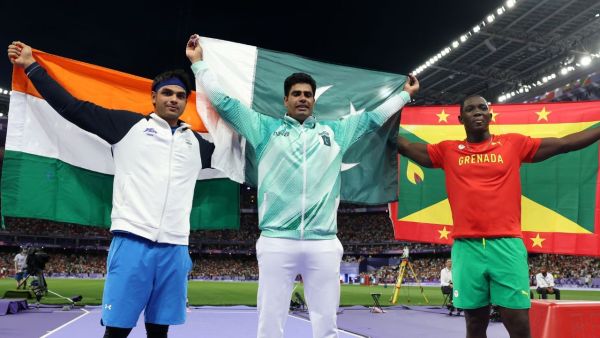
In the Paris Olympics 2024, Pakistani athlete Arshad Nadeem performed historically in the final of javelin throw. He threw 92.97 meters and created history by winning the gold medal. Now a big news has come out from Paris. According to Pakistani journalists, after Arshad Nadeem's victory, he was subjected to a dope test in the stadium. He stayed in the stadium for 2 to 3 hours for this test. At the same time, Neeraj Chopra had to settle for the silver medal with a throw of 89.45 meters. Apart from this, Anderson Peters of Grenada finished third with a throw of 88.54 meters and won the bronze medal. According to the report, these two athletes were also tested along with Arshad. Why were these three winners tested and what is this test? Let's know in detail.
What is a dope test?
In big tournaments like Olympics, many players use banned drugs or substances to improve their performance. Athletes often use psychoactive drugs, which affect the brain. These drugs affect the mood, awareness, feelings and behavior of the players, due to which players are able to play more than their capacity in difficult and stressful situations like finals. Dope test is done to prevent such cheating. In sports, this work is done by the World Anti-Doping Agency (WADA) so that no player improves his performance in an unfair manner and after a fair competition, only the rightful person gets the medal.
How is a dope test done?
Now the question is how is this test done? Actually this dope test can be done through the fluids present in the body. For this, the testing agency uses urine, saliva, sweat and blood samples from the body of the athletes. Apart from this, samples of hair and nails can also be taken. However, urine samples are usually used to test for doping.
There are two types of doping tests. First, a screening test is done through immunoassay. In this process, a specific protein or other substances are detected. This process is very fast and the result is obtained in a few minutes like a pregnancy test. Apart from this, the test is done through the Gas Chromatography-Mass Spectrophotometry (GSMS) process. This is a technique through which the chemical present in the body and its quantity is identified and analyzed. This test is a bit difficult to do, hence it is a bit expensive too. It also takes more time. After taking samples from the athletes, they are tested in a special kind of laboratory.
Which drugs or substances have been banned by WADA?
It is the responsibility of WADA to release the list of banned drugs or substances every year. WADA does this work on two bases. Firstly, those substances which improve performance in sports and secondly, those which affect the health of athletes. Apart from this, there are many categories like androgens, blood doping, peptide hormones, narcotics. A complete list is prepared under these. Let us tell you that drugs like heroin, morphine, codeine, buprenorphine and tramadol and many other substances have been banned by WADA for athletes.
When and where is the doping test conducted?
Doping tests can be conducted anywhere and at any time in the Olympics. As per WADA's anti-doping rules, players participating at the national and international level have to be prepared for this. Generally, this test is conducted after every medal event. This is a common procedure. That is why Arshad Nadeem, Neeraj Chopra and Anderson Peters had to stay in the stadium for this test.
These athletes have been caught in doping
The list of players who tested positive for doping is very long, who tried to improve their performance through it. The first case of this was seen in the 1968 Mexico Olympics. Swedish wrestler Hans-Gunnar Liljenwall was caught using banned substances during the bronze medal bout. After this, he was disqualified. Talking about the Paris Olympics, Iraqi judo player Sajjad Sahan and Nigerian boxer Cynthia Ogunsemilor have been disqualified after being found positive in the test.



BBL 2025-26: Match 19, HUR vs SCO Match Prediction – Who will win today's BBL match between Hobart Hurricanes vs Perth Scorchers?
David Miller: Loss of Rs 5.5 crore, now Miller set the field on fire, won the match by playing 38 balls

Rishabh Pant In VHT: Very bad happened with Rishabh Pant on the last day of the year!

BPL 2025-26: Match 9, SLT vs DHCP Match Prediction – Who will win today's BPL match between Sylhet Titans vs Dhaka Capitals?