
News Update
Tezzbuzz|20-07-2024
Rajasthan: Technology has completely changed today's era. New technology has entered every step of life. From lifestyle to children's education, people's jobs, technology has established a new dimension in the world of sports as well. Technology has played a huge role in cricket, one of the most interesting games in the world of sports.
6 techniques used in cricket that are not used in other sports
The game of cricket is years old. Its journey is about to reach 150 years. During this time, we have seen different technologies in this game from time to time. Technology has made this game very interesting as well as fair. There are many technologies which have made the work of umpires easy, and there are some technologies which have brought transparency in this game. In its journey so far, new technologies have been introduced in cricket and some technologies have also been discontinued.
Out of these techniques of cricket, let us talk about some special techniques today. Let us take a look at those 6 techniques which are definitely present in the game of cricket, but these techniques are not used in any other sport.
Smart Bells (Smart Bails)
The game of cricket has come a long way with time. Because now such technologies have come in it, which has made the work easy and the game interesting as well. One of these technologies is smart bails or LED bails… In this, when the ball hits the stumps, lights start flashing from the bails. In this, lights glow when the batsman is stumped, run out, as well as bowled, thus making the umpire's work easy.
Edge detection (Edge Detection)
It has been seen many times in cricket that when a ball touches the bat of a batsman, the umpires are not even aware of it. The ball goes into the fielder's hand with a slight touch of the bat, due to which the umpire faces difficulty in giving out or not out. In this, the edge detection technology has been most helpful. This technology tells whether the ball has touched the bat or not, where a sound is captured. This technology has overturned the decisions of umpires many times and it has had a big impact on the game.
Bird's eye view (Bird’s Eye View)
The camera technology in cricket has advanced a lot in today's era, such a technology which is never seen in other sports. One of them is Bird's Eye View or Spider Cam, in which a camera is seen hanging here and there in the air like a spider. This camera captures every angle of the field with the help of a very thin wire. This camera keeps moving around the entire ground in different dimensions. In this way, the audience gets to see the match from new angles. Due to which the interest in this game has increased.
Speed Gun (Speed Gun)
When a bowler bowls, the speed at which he is bowling is shown on our TV or mobile screen. After all, how is the speed of the bowler's ball determined instantly? This question is in everyone's mind, but there is a technology behind this as well. The name of this technology is speed gun. This technology takes into account the speed of the bowler's ball and the speed of the ball can be determined instantly through the speed gun.
Front foot technique (Front Foot Technology)
When a bowler bowls, he has to bowl from within the line of the crease at the non-strike end, but many times it happens that the bowler does not pay attention to the line and his foot goes ahead. Although the umpires keep a sharp eye on this, they declare it a no ball as soon as the foot goes outside. But the umpire is also a human being, who sometimes misses to see. For this the front foot technique is used. Till a few years ago the front foot technique was used for every wicket, but in today's era the front foot is checked for every ball. Due to this sometimes the batsman is saved from getting out on a no ball.
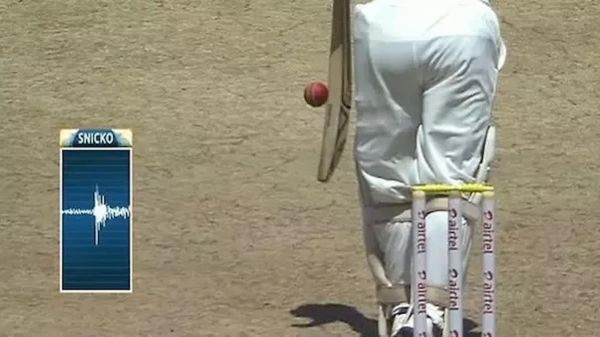
Snickometer (Snick-o-meter)
The snickometer technology is used to find out whether a batsman's bat is hit by a ball or not. The snickometer, which came out in 1999, is a technology that shows in the form of graphics whether the ball has hit the bat or not. This leaves a mark on the bat. When the ball has not hit the bat, there is no mark on the bat. This technology helps the umpires a lot in the form of catch out behind the wicket.




Rohit Sharma And Virat Kohli Close To Breaking All-Time Cricket Records In 2026

Smriti Mandhana Missing From The Great Indian Kapil Show: Fans Speculate

‘Got axed in a toilet’: The Christmas Day Ashes story you won’t believe

Australia vs England, 4th Ashes Test: When and where, key players, predicted playing XI, streaming details and more