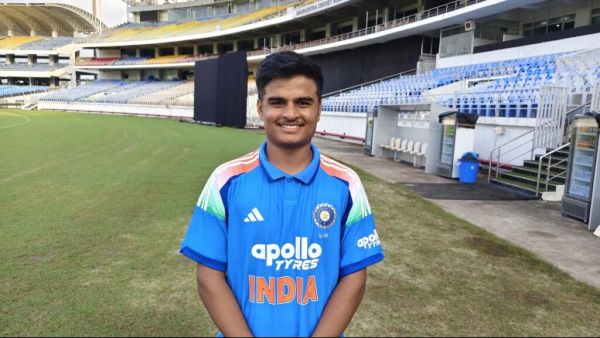
A couple of months ago, Yashbardhan Singh Chauhan was searching for answers.
After a difficult outing in Sri Lanka, where he had led India U-19, he turned to the coaches and asked: “ Why are you treating me like this?… (why is it happening to me?)”
Coach Yere Goud told him that it was okay to fail. In fact, he advised the youngster to cut out the outside noise and keep believing in himself.
Yashbardhan listened.
And on Friday, at the Niranjan Shah Stadium, he had one of those days that made the question seem a distant memory.
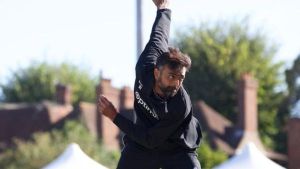
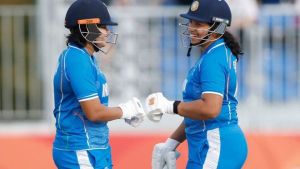
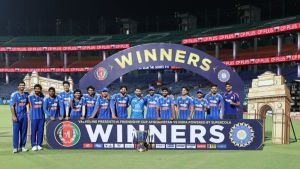
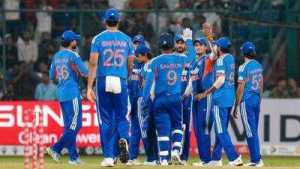
With India 88 for four in a rain-shortened Youth ODI against Australia, Yashbardhan walked in, steadied the innings and then changed gears. He scored 54 off 34 balls before returning to take two wickets, helping India win by seven runs and earning the Player of the Match award.
He is India’s vice-captain for this Youth ODI series against Australia, and will lead the side in the multi-day games that will follow.
But before the leadership roles, there was Chambal.
The runs came early
Yashbardhan grew up in Gwalior and played his early cricket for the Chambal Division.
He trained at Tansen Cricket Academy under Lavkesh Choudhary, but access to turf wickets was not always easy.His father Anami Singh Chauhan made sure that did not become an excuse.
“There were problems getting turf wickets. I mostly practised on cement wickets. For turf wickets, if I was in Gwalior and there was one available in Chambal, we would go to Chambal. Sometimes there was a ground in Gwalior itself, but it was far away. So my father travelled a lot with me,” Yashbardhan told Sports stars.
The travel was followed by runs.
In the U-13 AW Kanmadikar Trophy, he compiled a string of big innings, scoring 425, 235 and 391, amassing nearly 1,100 runs in a single tournament.
The performances drew the attention of Madhya Pradesh head coach Chandrakant Pandit.He moved through Madhya Pradesh’s age-group system and, within two years, was playing senior division cricket at just 15. Tasleem Khan, secretary of the Chambal Division, was one of the people who pushed him forward.
“He then gave me opportunities in U-15 and U-18, and within two years he even made me play in the senior division,” Yashbardhan said.
“Coming from Chambal and playing senior division cricket gave me an opportunity to understand how things work at the senior level. That experience is still helping me in my career,” he said.
His father had wanted to play at the highest level himself but never got there.
“He had a dream to play at the highest level, but he could not. He still has that passion. He talks about it even now,” he said, adding with a smile: “So, one of the biggest reasons I play cricket is that I want to fulfil my father’s dream. That is it.”
His father’s role, however, went beyond motivation.
He was there for the long drives, the practice sessions and the search for a decent wicket. Being the youngest in the family, Yashbardhan had a little more attention at home. His elder brother is pursuing higher education, as is his sister.“When you come from a small place like this, your family’s support matters a lot. My family has supported me from the beginning,” he said.
He has never romanticised the difficulty of coming from a place where facilities were limited. “I feel that if your mindset is right, the place does not matter. My mindset was simply that I wanted to play, and for that I had to work hard.”
Learning to play the situation
That attitude has carried into his batting. Yashbardhan does not see himself as someone who has to play one particular way. His role changes with the match.
“I play according to the situation. My main thought is – what can I do at that particular time to support the team?” he said.
That was exactly what Australia demanded on Friday. India was 88 for four when he arrived. He did not immediately look to force the pace. “We practise regularly for such situations. During practice, we keep different match situations in mind. If we are 88 for four or 84 for five, we think about how we have to take the innings forward from there,” he explained.
When he went in, around six or seven overs had been bowled.
“My thinking was simply to spend some time at the crease and support the team from one end,” he said, adding: “I felt that if I took a little time, a bowler would eventually come who would bowl a little slower or offer something lighter, and I could then take him on.”
Once he was in, the tempo changed.
“I knew that once I got settled, the runs would come. That was what I had in my mind – take some time initially and then accelerate later.”
As Yashbardhan stitched together a crucial 34-ball 54, one of Indian cricket’s most destructive batters watched from the stands. Virender Sehwag had come to watch his son Aaryavir. Yashbardhan had no idea he was watching.
Then came the ball. Yashbardhan claimed two wickets, dismissing openers Hayden Barbulovic and Neel Patel to help India secure a seven-run win.
On personal front, the tour of Sri Lanka was challenging. As India U-19 captain, Yashbardhan scored 43 runs in three Youth ODIs and 104 in two Youth Tests.
The difficult tour taught him to live with failure, shut out the noise and trust his game again. “I think that if you can handle pressure, then you can stand out in pressure situations,” he said.
For Yashbardhan, there is now a different way of looking at it: “Pressure is a privilege.”
No rocket science
For all the attention around him, Yashbardhan’s preparation remains uncomplicated. “I am very normal. I do not do anything like rocket science. I just get into my zone. I like doing normal things,” he said.
He does not have an elaborate ritual to get himself ready. If something important occurs to him, he writes it down, something that might help him later.
He also reads biographies of cricketers. Rather than having one particular idol, he looks around. “I get motivated by watching all cricketers. It is not one specific person. If I feel someone is doing well at that particular time, I try to learn something from them,” he said with a smile.