
Samira Vishwas
Tezzbuzz|22-07-2026
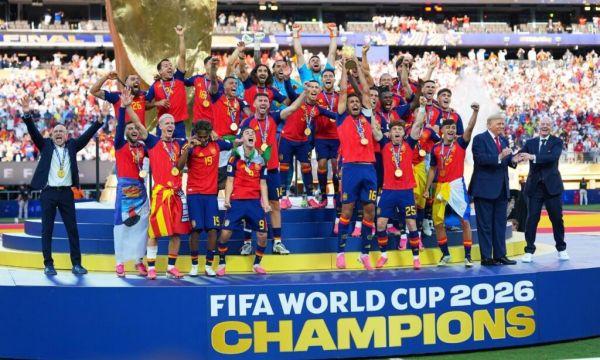
Spain are world champions for the second time after defeating Argentina 1-0 in extra time in East Rutherford, USA, on Sunday (July 19). The scoreline, however, hides what was one of the most one-sided FIFA World Cup finals in recent memory.
Also read: Mbappé becomes first two-time Golden Boot winner
For 120 minutes, Spain controlled almost every aspect of the contest. They dominated possession, dictated the tempo, forced defending champions Argentina into their own half and created chance after chance. Had it not been for goalkeeper Emiliano Martinez, the final could have been decided long before Ferran Torres finally broke the deadlock in the second half of extra time.
Winner in 106th minute
The Barcelona forward’s winner in the 106th minute will be remembered as the decisive moment, but it was merely the culmination of sustained Spanish dominance. The real story of the final was not Torres’ goal. It was Spain’s complete control and Argentina’s inability to respond.
Spain’s Ferran Torres (7) celebrates scoring a goal. AP/PTI
Spain finished with 65 per cent possession and completed an astonishing 852 passes. Argentina managed only 464. Those numbers illustrate the gulf between the two sides better than any tactical diagram could. Spain did not simply keep the ball; they deprived Argentina of any rhythm, forcing Lionel Scaloni’s side to spend most of the evening chasing shadows.
The shooting statistics were equally telling. Spain attempted 20 shots, with 12 on target. Argentina struggled to create meaningful opportunities. In effect, the final became a contest between Spain’s attack and Emiliano Martinez.
Martinez’s 11 saves
The Argentine goalkeeper produced 11 saves, setting a World Cup final record. Time and again he denied Spain with outstanding reflexes, keeping out efforts from close range and preventing what could easily have become a humiliating scoreline. Every save delayed the inevitable and kept Argentina’s hopes alive far longer than their overall performance deserved.
Also read: Saka’s hat‑trick seals England’s 6‑4 thriller over France in record‑breaking World Cup clash
Martinez was arguably Argentina’s best player by a considerable distance. Without him, Spain might have won by three or four goals.
Messi’s poor show
Equally surprising was Messi’s anonymous performance. The tournament had once again built its narrative around the Argentine captain, with expectations that he would produce another defining moment. Instead, Spain rendered him almost irrelevant.
Argentina’s Lionel Messi (10) is dejected after losing to Spain. AP/PTI
The most remarkable aspect of Messi’s display was not that he was tightly marked. In many phases of the game, Spain did not even need to assign special attention to him. Argentina struggled so badly to retain possession that the ball rarely reached their captain in dangerous positions. When it did, Spain’s midfield quickly closed down the passing lanes.
It was a performance far removed from the magic Messi had produced throughout the tournament. As Spain monopolised possession, the Argentine captain became an isolated spectator for long stretches.
Fernandez sent off
If Spain’s dominance reflected tactical clarity, Argentina’s approach raised uncomfortable questions. Rather than pressing aggressively or attempting to disrupt Spain’s rhythm, they retreated deeper and deeper. The result was that Spain enjoyed wave after wave of possession without sustained pressure.
Argentina’s frustration became increasingly evident. Fouls accumulated. Yellow cards followed. The situation worsened when Enzo Fernandez received his second booking and was sent off in the second half, reducing Argentina to 10 men for the closing stages.
The dismissal effectively ended any realistic prospect of Argentina mounting a late response. Already exhausted after chasing the ball for over 100 minutes, they now had even fewer players to contain Spain’s relentless passing game.
Spain’s wastefulness
The only criticism Spain might face concerns their finishing. Despite overwhelming superiority, they needed extra time to score the decisive goal. Their final pass often lacked precision, and several promising moves ended with misplaced crosses or rushed finishes.
Against a more clinical opponent, such wastefulness could have proved costly. Spain created enough chances to settle the contest inside 90 minutes but repeatedly failed to convert them.
Yet their persistence never wavered. They continued circulating possession patiently, trusting that space would eventually appear. It finally did when Ferran Torres found the breakthrough that Spain had threatened throughout the evening.
Tactical and technical outclassing
For Argentina, the defeat will prompt serious reflection. Losing a World Cup final is painful. Losing one while barely imposing yourself on the game is even harder to accept. This was not simply a defeat; it was a tactical and technical outclassing.
Scaloni’s side, so often admired for their resilience and ability to adapt, appeared reactive from the opening whistle. They surrendered the initiative early and never found a way back into the contest.
Spain, meanwhile, delivered the kind of performance that reaffirmed their footballing identity. Control through possession, patience in build-up and relentless pressing defined their triumph. They did not merely win the World Cup. They demonstrated complete superiority over the defending champions.
History will record Spain’s victory as a 1-0 win after extra time. Those who watched the final will remember something very different: a match in which one team monopolised the ball, one goalkeeper delayed the inevitable, and one of football’s greatest players was reduced to a peripheral figure on the biggest stage.




BCCI To Make Big Call On T Dilip After Fielding Decline, Coach Misses Zimbabwe Tour

Flight hours, miles of World Cup travels of FIFA’s Infantino in numbers

Fragile bodies, fragile bowling: India’s Lord’s defeat exposes deeper cracks

The Hundred 2026 — Smriti, Jemimah among four Indians set to feature