
Samira Vishwas
Tezzbuzz|27-08-2026
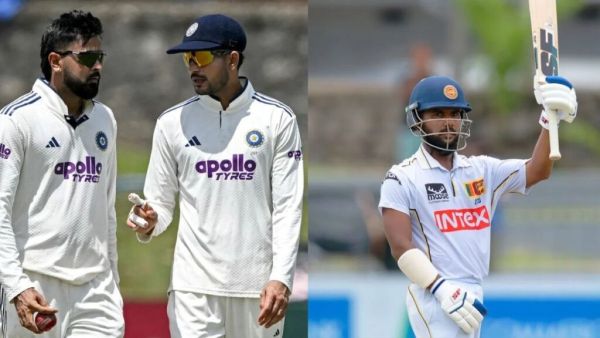
Delhi: The second test played between Sri Lanka and India in Colombo ended in a draw. However, it would not be wrong to consider this as a victory for Sri Lanka. In the initial days of the match, the Indian team was in a strong position and at one time it seemed that Shubman Gill's team would easily win the series 2-0, but in the last two days, the Sri Lankan batsmen showed tremendous struggle and snatched the victory from the jaws of India.
The biggest contribution in this was made by Sonal Dinusha, who was adjudged Player of the Match.India had a big lead and Sri Lanka was playing follow on. Despite this, the Indian bowlers could not take the last four wickets. Some such decisions and shortcomings came to light in this match, due to which India could not achieve the target even after coming very close to victory. In this article we will mention 3 important decisions.
1. The decision to follow on was heavy on India
India gave follow-on to Sri Lanka after making a big score in the first innings.
At that time this decision seemed absolutely right. India had a big lead and Sri Lanka had lost six wickets, but after the follow-on, the Indian bowlers had to bowl for the second consecutive innings. This thing later became a problem for the team.If India itself had batted in the second innings, Sri Lanka would have had to chase the target in the fourth innings. In such a situation, the turn present on the pitch could have proved more helpful for the Indian spinners.
By giving follow on, India gave Sri Lanka a chance to bat again and the host team fully capitalized on this opportunity.
Due to continuous bowling, the energy of the Indian bowlers also gradually decreased.Captain Shubman Gill also admitted after the match that the decision was taken keeping in mind the weather at that time. India were not confident that the full game would be played on the fifth day. Therefore, the team took the decision considering the circumstances available at that time.
2. Jadeja and Suthar could not take wickets despite the turn
The ball was spinning on the Colombo pitch, but it did not have much bounce and speed.
This was the reason that the Sri Lankan batsmen had enough time to read the ball and play their shots.Ravindra Jadeja and Manav Suthar tried to rotate the ball, but the Sri Lankan batsmen showed good preparation against both of them. He played the ball forward and also used sweep and reverse-sweep.
Due to this, Indian spinners did not get a chance to bowl on the same line and length. Despite his tight bowling, Jadeja could not take wickets continuously.
On the other hand, Manav Suthar had performed brilliantly in the entire series, but in this innings he could not get the wicket-taking ball consistently.
The effect of long spells and continuous bowling was also clearly visible.It would not be right to blame only the bowlers here. To take wickets on a slow pitch, constant changes in ball speed, flight and field setting were necessary. Sri Lankan batsmen took advantage of these things.
3. India does not seem to have a concrete plan for Sonal Dinusha
If any one batsman troubled the Indian team the most in this Test series, it was Sonal Dinusha. Dinusha scored 420 runs in four innings of two test matches. He scored three centuries in the series and played a match-saving inning of 133 not out in the second innings.
The most surprising thing was that in front of India, only one batsman was scoring runs continuously in the entire series, but there was no such plan against him so that he could be dismissed quickly.
Even in the second innings of the second test, Dinusha held one end. Indian bowlers kept trying different methods, but could not find a way to get him out. Dinusha played every ball patiently and scored runs whenever she got a chance.
His innings not only increased the score but also wasted a lot of time for India. This time ultimately became the biggest problem for Team India.



SL vs IND: Heavy threat of rain on India's victory in Colombo Test, know how the weather will be on the fifth day
Virat Kohli’s On-Field Foe Announces Retirement, Reveals Final Match Details

ICC Ranking: Mitchell Starc became the number-1 Test bowler by defeating Jasprit Bumrah… created history for the first time in his career…

ETPL 2026 Begins Today: Faf du Plessis, Mitchell Marsh Set for Dutch Derby